Rocket Money vs Gravity isn’t really a head-to-head between two similar apps — it’s a choice between two fundamentally different philosophies for tracking subscriptions. I’ve covered both separately in my Rocket Money review and my subscription tracking apps roundup, so this is the direct comparison for anyone deciding between the two.
This is part of my ongoing series reviewing subscriptions and software to help you figure out what’s worth paying for.
Note: pricing and features for financial apps can change. Double-check current details directly on rocketmoney.com and Gravity’s official site before signing up.
Rocket Money vs Gravity: The Core Difference
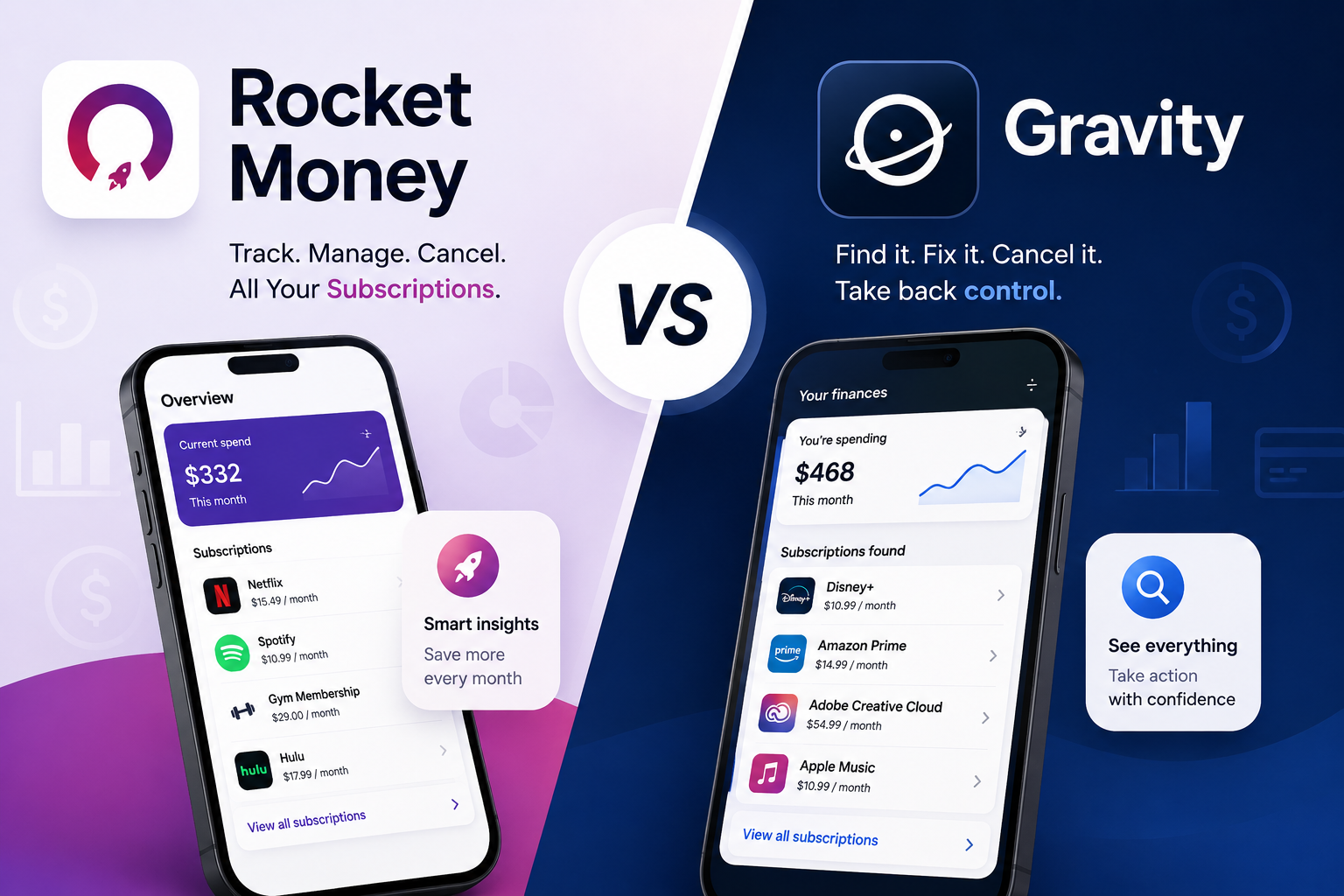
Rocket Money links directly to your bank and card accounts and automatically detects recurring charges — no manual entry required, but you’re granting a third party read access to your financial accounts. Gravity takes the opposite approach: no account linking at all. You enter your subscriptions manually, and it tracks renewal dates and trial deadlines while providing step-by-step guidance to cancel each one yourself.
Neither approach is objectively better — it depends entirely on how you weigh convenience against privacy.
Rocket Money vs Gravity: Pricing
- Rocket Money: Free plan available (tracking, spending insights, credit monitoring); Premium is “pay what you think is fair,” typically $7-$14/month
- Gravity: No free tier; roughly $19.99/month or $59.99/year
Rocket Money is the cheaper option at every tier, including a genuinely usable free plan that Gravity doesn’t offer an equivalent to.
Where Rocket Money Wins
- Automated detection — charges are found automatically once your accounts are linked, with no manual upkeep required
- Free tier available — meaningful functionality without paying anything
- Bill negotiation — a feature Gravity doesn’t offer at all, with no charge unless negotiation succeeds
- Broader financial overview — budgeting, net worth tracking, and spending insights beyond just subscriptions
Where Gravity Wins
- No bank account linking required — for anyone uncomfortable granting a third-party app access to financial accounts, this is the clearest differentiator
- Step-by-step cancellation guidance — walks you through canceling each service yourself rather than just flagging it
- More predictable pricing — a flat fee rather than Rocket Money’s variable bill-negotiation cut
Rocket Money vs Gravity: Quick Comparison
| Feature | Rocket Money | Gravity |
|---|---|---|
| Free tier | ✅ Yes | ❌ No |
| Bank account linking | ✅ Required | ❌ Not required |
| Charge detection | Automated | Manual entry |
| Cancellation help | Premium concierge (does it for you) | Step-by-step guidance (you do it) |
| Bill negotiation | ✅ Available | ❌ Not available |
| Monthly cost | Free, or $7-14/mo Premium | ~$19.99/mo (or $59.99/yr) |
Who Should Choose Rocket Money
- You’re comfortable linking bank and card accounts to a third-party app
- You want automated detection without manually entering every subscription
- You’re interested in bill negotiation as an added feature
- Budget matters — Rocket Money’s free tier and lower Premium cost make it the more affordable option
Who Should Choose Gravity
- You specifically don’t want to link any financial accounts to a subscription tracker
- You’re comfortable manually entering your subscriptions in exchange for that privacy
- You want cancellation guidance you follow yourself rather than automated concierge cancellation
Frequently Asked Questions
Is Gravity safer than Rocket Money? “Safer” depends on your definition — Rocket Money uses bank-level encryption for the accounts it links, so it’s not inherently unsafe. Gravity simply removes the question entirely by never requesting account access in the first place.
Which is cheaper: Rocket Money or Gravity? Rocket Money, by a significant margin — its free tier alone offers more functionality than Gravity’s paid-only model, and even Rocket Money Premium typically costs less than Gravity’s flat monthly fee.
Can Gravity actually cancel subscriptions for me? Not automatically — Gravity provides verified, step-by-step guidance for canceling each service, but you carry out the cancellation yourself rather than the app doing it for you.
Which is better for someone with many scattered subscriptions? Rocket Money’s automated detection is faster for surfacing subscriptions you’ve forgotten about entirely, since it scans your actual transaction history rather than relying on you remembering to enter them.
Final Verdict
Rocket Money vs Gravity comes down to a genuine tradeoff: automation and a lower price with Rocket Money, versus privacy and manual control with Gravity. For most people comfortable linking financial accounts, Rocket Money’s free tier alone makes it the easier starting point. For anyone who specifically doesn’t want a subscription tracker touching their bank accounts, Gravity fills that gap well, at a real cost premium for the privacy tradeoff.
My rating: Rocket Money 4.1/5 for value and automation, Gravity 3.8/5 for privacy-conscious users willing to pay for it